|
Alice Stone Blackwell
Biography
Alice Stone Blackwell was born September 14, 1857 in Orange, New
Jersey before her parents returned to Boston in 1870. She was the
only child of Henry Browne Blackwell and Lucy Stone. Her mother,
Lucy Stone, was the first woman to earn a college degree in Massachusetts,
the first woman to keep her maiden name when she married and she
was also the first woman to speak full-time on woman’s rights;
Lucy Stone is credited for introducing the woman’s rights
movement to Susan B. Anthony (Balakian 95). Alice also had an aunt,
Elizabeth Blackwell, who was the first woman to graduate from medical
school in the United States and also “founded The Women’s
Medical College” (Balakian 16).
In 1881, Alice Stone Blackwell graduated from Boston University,
Phi Beta Kappa. She then went to work as an assistant editor for
her parents who founded the Woman’s Journal, the official
magazine for the American Woman Suffrage Association (AWSA).
In 1890, Alice led the movement to reconcile the two competing
factions of the woman’s suffrage movement—American Woman
Suffrage Association and National Woman Suffrage Association—into
the National American Woman Suffrage Association (NAWSA); she served
as the recording secretary of this organization until 1918.
 |
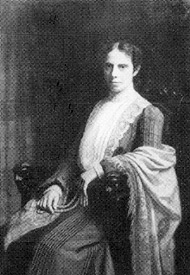
Alice Stone Blackwell, between 1880-1900
Image courtesy of Library of Congress |
In 1893, Alice’s “aunt” Isabel Barrows—actively
involved in the Armenian movement in Boston—met Ohannes Chatschumian,
a theology student, in Leipzig, Germany. Isabel persuaded Ohannes
to come visit her and her husband in the United States. Alice Blackwell
met Ohannes and “she began to learn in greater detail about
the worsening plights of the Armenians” (Balakian 17). “Isabel
suggested that Alice and Ohannes collaborate in translating ‘some
of Armenia’s touching and beautiful poetry into English verse’”
and they began working on “The Tears of Araxes” by Raphael
Patkanian (Balakian 18-19).
In the fall of 1893, Lucy Stone died and Alice took the position
as editor-in-chief of the Woman’s Journal. It was also
“the moment she found her self engaged in the Armenian Question”
(Balakian 94). Alice and Ohannes created a society known as “Friends
of Armenia” and “before long Friends of Armenia expanded
and became central to launching America’s first international
human rights movement” (Balakian 19). “For Alice equal
rights for women was the bedrock on which her life rested, and her
passion for Armenian human rights had its origin there” (Balakian
94). The society provided information about the Armenians and the
Armenian Question to American media. Julia Ward Howe—author
of the Battle Hymn of the Republic—was president of the society.
In 1894, while Alice and Ohannes were still translating Armenian
poetry, Ohannes decided to return back to Leipzig to finish his
studies although his health was deteriorating (Balakian 98). “After
Ohannes left for Leipzig, Alice teamed up with Bedros Keljik, who
translated the remaining poems with her to finish the anthology”
(Balakian 101). Ohannes Chatschumian died in May, 1896, the same
year Alice had Armenian Poems published.
The anthology presented several dozen poems, most of them by nineteenth
century poets such as Bedros Tourian, Michael Nalbandian, and Raphael
Patkanian, who were part of a renaissance in Armenian culture…Well
armed with appendices, the book had an introduction about Armenian
history and the recent massacres, as well as essays about the Armenian
church and the advanced status of Armenian women. (Balakian 101)
Due to the book’s success, the first publication sold out
within days. It is most likely the only book in the world to be
reprinted fifteen days after it was first published. (Mirzabekian)
On May 30, 1904, two hundred of Alice Blackwell’s friends
organized a celebration in her honor for ten years of literary work.
During the event her
portrait painted by Carnig Eksergian—an Armenian American
portraitist—was presented to Alice by her Armenian friends.
(Mirzabekian)
In addition to Armenian Poems, Alice also translated several other
volumes of poetry into English from Russian (Songs of Russia,
1906), Yiddish (Songs of Grief and Gladness, 1907), Spanish
(Some Spanish-American poets, 1929), Hungarian and French.
In 1917 she edited The Little Grandmother of the Russian Revolution
which is about the life of Catherine Breshkovsky.
Also in 1917, the second and enlarged edition of Armenian Poetry
was published containing 135 poems in total. Atom Yarjanyan (Siamanto),
Daniel Varoujan, Hovhannes Toumanian—along with many others—are
some of the poets added to this second publication.
Alice remained the editor in chief of the Woman’s Journal
for thirty-five years—until 1918—and then began writing
her mother’s biography, Lucy Stone: Pioneer of Woman’s
Rights which was published in 1930.
In 1945, Alice received an L.H.D. degree (Doctorate of Humanities)
from Boston University in recognition of her work.
When Lucy Stone died in 1893, she was the first New England resident
to be cremated. Alice Stone Blackwell followed in her mother’s
tradition when she died March 15, 1950 at the age of ninety-two.
WORKS CITED
Balakian, Peter. The Burning Tigris: The Armenian Genocide and
America’s Response. New York: HarperCollins Publishers,
2003.
Mirzabekian, Emma. “The Friend and Translator of Armenian
Poetry” (Droog i perevodchik armyanskoj poezii). Planeta
Diaspor Magazine. January 24, 2000.
OTHER SOURCES
“Alice Stone Blackwell.” Biography Resource Center
October 2003, Gale Group Incorporated.
“Biographies of Suffragists.” University of Rochester
October 2003, < http://www.rochester.edu/SBA/biographies.html
>.
Blackwell, Alice Stone. Armenian
Poems, Rendered into English Verse. Boston, MA: Atlantic Printing
Company, 1917.
“Women’s Suffrage.” American Memory, Library
of Congress October 2003,
< http://memory.loc.gov/ammem/awhhtml/awmss5/suffrage.html
>. |